



Several months ago, I was on the edge of overload. I had a number of great projects in progress, gallery sales were humming along, and the little things that a business owner has to deal with were beginning to compound. Add to that dealing with dozens of emails each day, random phone calls, traveling, and meetings (not to mention writing for this blog), and, quite simply, there weren’t enough hours in the day to get it all done.
Though I am fortunate to have a high stress tolerance, I was beginning to feel the weight of carrying a workload that was simply too high. Many days I would start work before 8:00 a.m., work all day, come home and, after dinner, work again until 10 or 11 at night. Even so, each day I felt I was falling just a little further behind in accomplishing everything I wanted to get done.
On a regular basis, I have the opportunity to talk to artists and have found that many are experiencing exactly the same predicament.
You might not think of it this way, but as an artist you are the owner of a small business
You might not think of it this way, but as an artist you are the owner of a small business, just as I am. As the owner of your fine art business, you have to manage your accounting, your inventory, and your marketing. You have to find time to build and maintain relationships with galleries. If you sell your own work, you have to manage your sales, both by making sure that you are developing new leads and following up and closing sales. You are responsible for managing your website and following through with your social media. These tasks alone could keep you busy most days, and we haven’t even mentioned your most important work: creating art.
I am sure that many of you can understand the desperation that was beginning to creep into my days.
Luckily for me, I was directed to some tools that have changed my day-to-day life and helped me get control of my time.
I don’t want to cast myself as a time-management expert, nor is my intention to write an all-encompassing post on how to get control of your life. I just want to share a few things that have had a huge impact for me and could help you become more productive and feel like you are in control of your day, and more importantly, your overall direction.
The Ideal Week
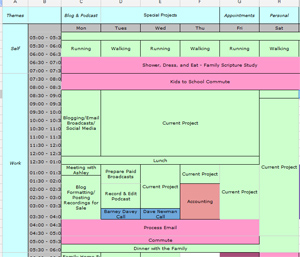 Many of you know Barney Davey through podcasting and workshops we have done together. Barney is a fountain of great information and he is particularly good at finding great tools and resources online. I consider him to be my digital guru. Several months ago, Barney pointed me to Michael Hyatt’s blog.
Hyatt is the former president and CEO of Thomas Nelson Publishers and blogs about leadership at michaelhyatt.com. While his blog posts cover a wide range of leadership topics, Barney directed me to an article on planning, where Hyatt describes how he designs an “ideal week.” I recommend you read Hyatt’s post by clicking here.
I won’t attempt to repeat everything Hyatt writes. but the basic concept is that by creating a template of your week – scheduling out your time in blocks – you become more efficient and complete your most important work. Obviously Hyatt isn’t the first to discover the concept. This is a bedrock time-management principle, but the timing was just right for me. I read his article at exactly the moment when I needed to have more control over my activities. Hyatt includes a downloadable spreadsheet that you can adapt to your schedule, and I did just that.
the act of creating the ideal week was revealing – it forced me to prioritize so that I could allot my time to those tasks that are most important to me.
Again, this isn’t rocket science, and after creating my own ideal week, it seemed so obvious I couldn’t believe I hadn’t done it before. Just the act of creating the ideal week was revealing. It forced me to prioritize so that I could allot my time to those tasks that are most important to me. Reading Hyatt’s post, you’ll see that he suggests starting your day with your long-term priorities, rather than your day-to-day tasks.
Prior to this exercise, I would sit down at the beginning of each day, look at my task list (more on that in a moment) and try to plan things out as best I could. The problem with this is that prioritizing on a daily basis often caused me to work on projects that were urgent rather than important.
I encourage you to try and plan your own ideal week and see what it looks like. I suspect that the biggest blocks of time on your schedule will be for your creative process and production time.
Once I had my ideal week on paper, I was surprised by how easy it was to begin following my plan. I created my spreadsheet in Google Docs and I have it set as a permanent tab in my browser so it is always easy for me to access. I look at it every day to make sure I know what I need to be working on that particular day.
The To-Do List
I have long been a fan of the to-do list. I always have dozens of little tasks pending, and prior to using a to-do list I would often drop the ball on some of these minor tasks. Several years ago, I converted to managing my email in Outlook and started using the integrated task list in the program to make sure I was getting everything done. This was another revolution in my life. Any of you who have used Outlook before know how easy it is to create a task or convert an email into a task, set a due date, and then manage the list.
In May of this year, I moved the gallery’s email to Google for hosting through their gmail system. I kept hearing how wonderful gmail was at cutting through the clutter of the inbox and making it easier to manage. I’ll have to write another post on how amazing I have found gmail to be, but the one downside was losing Outlook’s great tasking system. Gmail offers a to-do list, but after trying it I found that it simply wasn’t robust enough to deal with my tasking.
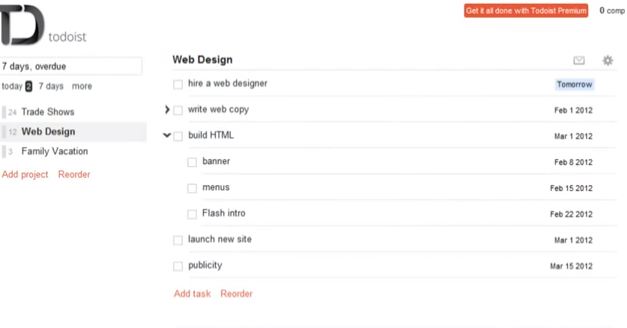 Barney Davey saved me again by pointing me to todoist.com. Todoist is an online task and project management web app that not only gave me back a lot of the flexibility to move tasks around and prioritize them (as Outlook had) but gave me a cleaner interface and a workflow that felt more natural to me.
Quite simply, whenever a project or task comes up, I put it into Todoist.
Prior to using a to-do list, I would be tempted to simply go to work on every thought or idea that popped into my head. Consequently, I would bounce around from project to project because, invariably, as I was working on one project I would have an idea for another.
Now if I have an idea or realize I need to do something, I pop into Todoist (also a permanent tab in my browser), create a task (by simply hitting ctrl+q), assign it a date, and go back to my original project. Because I am secure in the knowledge the task won’t be forgotten, I can now forget about it and get back to the original work I was doing.
My to-do list works in tandem with my ideal week. I plan out my broad strokes with the ideal week schedule and manage the little tasks involved in each project or day-to-day activity in my to-do list. I do have to be a little bit careful about not looking at my to-do list at the beginning of the day for fear that I will be derailed by the little things it contains. I work on my big projects in the morning and through about 2:00 p.m., and then I look to my to-do list to manage the rest of my day and get everything done.
Delegate
Perhaps the hardest thing for any small business owner to do (and remember, I consider you a small business owner) is to let go of some of the control of any aspect of your business by delegating it to someone else. As small business owners, we often have to figure out how to do everything on our own – all the way from the most important business decisions down to cleaning the bathroom. After a while, it becomes a way of life and we feel pretty good about the fact that we can do so much by ourselves.
Ultimately, however, our self-reliance can become a hindrance to our long-term success. Yes, you can do your own bookkeeping and taxes, and yes, you can ship your own art, and yes, you can clean the bathroom, but is doing these things the best use of your limited time?
A week consists of 168 hours, and every minute you spend on one task is a minute you can’t spend on another.
I am fortunate to have great people working for me, and the work they do for me frees me to focus my efforts on the work that I have prioritized as most important for our long-term success.
You might say, “I’m a starving artist, I can’t hire anyone.” Indeed, you may not be able to hire someone to work full-time for you, but if you can simply farm out some of the more basic parts of your business, you will find you have more time to create. Consider having a bookkeeper take over your day-to-day financial record keeping. Hire an art student to come into your studio weekly to organize and clean the studio and catalog your artwork. Have your spouse take over your website maintenance.
To my delight, I have found that not only can others do the work I was originally doing myself, after a little training they often do it better than I could!
Learn to Say “No”
While you may have countless great ideas and opportunities, none of them are any good to you if you can’t get them done. Sometimes you just have to learn to put your foot down and say “no” to things that are going to prevent you from accomplishing your priorities. Again, your ideal week can be a huge help in budgeting your time in relationship to “opportunities” that might pop up.
You might be approached by a charity that is looking for volunteers to help with an event. If you believe in the cause it can be very difficult to decline. Before you accept, however, go to your ideal week calendar and ask yourself where you can fit in the commitment and how much time it’s going to require. If you’re not willing to give up other priorities to fit the commitment in, decline the opportunity.
Michael Hyatt has another great post on saying “no” in a positive way: http://michaelhyatt.com/how-to-say-no.html.
Eliminate Distractions and Create a Buffer
Prioritizing and planning are meaningless if you can’t stay focused while you are working on your priorities. We live in a world of constant distraction. Email, phone calls, television, and even friends and family can intrude on our productive time and prevent us from accomplishing our goals. Once again, the urgent can get in the way of the important.
I experienced another huge productivity increase when I simply changed my habits around my email. I used to work on my email first thing in the morning. I would arrive at the gallery before 8:00 a.m. and open my inbox to get to work on clearing it out. Inevitably, I would end up stuck in my email for hours and sometimes all day. Email comes in at a steady stream, so just when you think you have it licked, another message rears its ugly head.
Now, I don’t even open my email until after 3:00 p.m., and yet, amazingly, I can still manage to respond to all of my correspondence before the end of the day.
I try to do the same thing with phone calls – I ask my staff to take messages or I let calls roll over to voice mail so that I can deal with them on my time. Obviously there are exceptions, but most emails and calls aren’t so urgent that they can’t wait a few hours so that you can stay focused on your most important work.
I have also found that I am less distracted if I create a physical and psychological buffer between myself and the world around me. A closed office door (or studio door in your case) and headphones create enough of a barrier that all but the most insistent distractions are blocked. While the wrong music could be another distraction, I have found that classical music and instrumental movie soundtracks actually help me focus.
The Payoff
I know these suggestions are pretty simple, but it’s amazing how taking control of my time has impacted my outlook on life. At the end of each day, I can now look back with satisfaction on the work I’ve accomplished and the progress I’ve made toward my goals instead of feeling guilty that I didn’t get everything done.
Managing my time more carefully has, almost miraculously, given me more time to stop and smell the roses of life. Over the last several months, I have read two lengthy books to my children and spent more time with my wife, Carrie.
There is still much more I need to do to optimize my time and work and I’m not always 100% consistent, but at least now I feel like I am on the right track and have the tools at my disposal to take advantage of the time I have available.
What are your greatest time management challenges? What tools do you use to maximize your productivity? How does your control of your time impact the art you are creating?

~ My sidewalk art showings are long in he past as learning to delegate delivery to clients local businesses or with in the state of Texas has resolved much for me – ‘Living in the Now’ and going with the FLOW 2022 takes priority in the creative process 24/7 in my Houston Studio/Home – One ‘Happy Artist’ for sure! ~ ~ ~
So “true” when posted and takes priority in this crazy world today March 2023. Love the idea of “Going with the FLOW in acceptance and to surrender to the “inspiration that flows” ~ for sure from a source we can not explain in words but only with the ‘awareness’ of NOW . . .
Excellent advice and practical help. Thank you for this article.
Oh Jason I got tired after reading your article!!! Learning to say no is probably the most important item on this list. Once I started to only say yes for things that
1. Paid well
2. Were beneficial to my long term goal
then everything changed, time opened up magically.
Also paying people to help, getting out of the poor artist mentality was a huge leap of faith. I figured if I make $50/h painting, even though I only make the money when I sell the art, paying someone $20/h to edit images on photoshop or manage my website allows me to put energy toward
1. what pays well
2. what serves my long time goal
which is painting!
With the energy, time and focus, my paintings also started to sell better!
Great advise as usual. You are a busy man!
I set up my art business last year and fortunately I had years of professional sales & owning my own design business to help with the initial organization. In sales I had to be organized to survive & still use the basic tools today. I am retired & not a busy as you by any means but I use my Google calendar on the monthly view, so I can look at my appointments etc a month at a time. I learned to color code by priority years ago, so I can see whats most important for the day or even weeks in advance. I got into the routine to input a note or appt immediately no matter what, then I could forget about it as a task until the appropriate time. It helps you focus on the moment to get things done & they are all previously prioritized. Once you get used to creating appts in Google Calendar you can add more details like some repeating a weekly or monthly task, or it sending reminders.
I also decided to hire a bookkeeper from the start. I can do the job but its my least favorite, so I decided to hire someone to set up my business & maintain it. She even balances my bank statements & pays my sales tax at the right time. So worth the money invested, what she does in minutes save me hours of work & I can invest that in creating art. I still use my Google calendar to block out times for routine business jobs like marketing, researching, local sales opportunities, updating my website & what ever else it needed. Once I block out the time for business & personal things, I don’t have to think about it anymore, for I know it will get done at the right time with enough time allotted. I also block out personal time which is just important, dinners with hubbie, lunches with friends, yoga class, taking the dog for a long walk, works for those needed breaks too. I have the option to create new business appts around personal errands & social dates. Do unexpected things come up, yes. Do distractions happen, yes, but I just reschedule it on my calendar & move on. Takes literally seconds.
Its takes time to organize, set up & learn a new way of doing things but once you have it down & its a simple routine, it actually offers more free time and peace of mind. I think it guarantees success in the long run, both in business & personal lives, helps keep you balanced in both worlds.
Appreciate you constantly sharing your learning and insights Jason. Always spot on. Even though often not carried out as I would like….but I have given myself one gift and that is a social media student…now for someone to help with that “ideal week” setup. Thanks again and stay well. 😎🇧🇸
Thanks so much for reminding me about time management. I write lists and always try to focus on the essentials but life happens, often to throw me into the non essentials. Some while ago I created my ideal week and need to revisit it. We can become so much more efficient and get more accomplished when time management has been mastered. When we enjoy a daily rhythmic, consistent but not rigid or fanatical routine we can achieve our goals and become successful.
Thanks for the refresher course and interesting links. Once of the things I’m still having a hard time getting used to is having gotten old. I can’t put in an eight hour work day like I used to. If I have too many projects or tasks exciting my imagination, I get overwhelmed in a way I didn’t used to.
My solution is to yes, keep a master list of projects and steps, but every morning, I select just one to get done plus two household chores. I give that one task my full attention. I refuse to worry about self-imposed deadlines.
If I don’t complete the task, I pick it up again the next day. If I do complete it, I don’t start a new one but pick off a few more smaller items on my to-do list.
I’m surprised at how much re-charging time this old body needs, but it is my highest priority: food, exercise, rest, sleep.
I am going to do the Ideal Week template, and it will be so much simpler and slower than it would have been just five years ago. But that’s okay. I’ve still got skin in the game, and I’m enjoying it, now, while I have my health and enthusiasm for life and art.
Turned out to be a little life manifesto, for some reason —viva la Vida!
As an artist whose lowest common denominator is being in front of an empty space and filling that void with an image, the world with all its busy pace is nothing more to me than one huge distraction. War, Wall Street criminals, cyberspace criminals, world news in general, social media podcasts (present company excepted) all remind me of the line from Shakespeare: “…like a tale told by an idiot, full of sound and fury, signifying nothing.”
Your article Mr H definitely resonates. One thing I do to isolate myself is simply turn all devises OFF from am to pm allowing only for an hour or so in the evening to read e-mails and podcasts that I find pertinent to who I am and not what the world is.
Learning to say No..
Years ago as a consultant/entrepreneur, when i had this problem, I took my new annual appointment book and wrote NO at the top of every page to remind myself it was an option. Worked great. I also was very specific about how many volunteer activities I could manage, 3, and until one of them ended I just did not accept more.
Years later, post consulting, when it was phone calls to “get together” or whatever, I made a funny little sign to stick on my phone that read, “Thank you, but I already have plans.” Again, to remind myself. My plans might have been writing, painting, or a bubble bath, but no one ever questions those words.
We creative have to work harder than others to protect our time and get it all done. It’s another aspect of the “pay yourself first” idea. No apologies needed!
Having run global art business ventures and being an artist for the last 50 years taught me to delegate rather ruthlessly. i worked with staff as part business owners rather than employees. learning to trust ones judgements and say no were the strongest lessons. Emphasizing relationships over money was the other. no recriminations when a gallery managers decision did not prove out. i could not possibly be in 67 different countries simultaneously so delegation was key to survival. i would literally do anything to save myself from actually operating one of the galleries i owned. while running a global business i still painted for many hours each day with blocs of time set aside for concentrated art projects.
As a scientist I foĺowed two guidelines:
Start each day by spending 30 focused minutes generating and recording creative ideas before routine distracted. Use this time to ask is this a good idea? What do I need to know to test the idea? What tools do I need? Review weekly, or when “blocked”.
Don’t spend too long trying to solve a problem. A university president was once asked what distinguished Noble prize winners. His response “they know when to give up.and move on to their next idea.” E.g. come back to the idea when the techmology needed becomes available, etc.
I also kept a notebook within easy reach to record ideas that popped up in the middle of the night. My wife adjusted to me getting up to record ideas. This allowed me to clear my mind and sleep.
Creativity is important in every meaningful endeavor.
You hit on the most difficult failure area of my art career; time management. When I retired, I thought I would have plenty of time to really get in to my painting again. I found that so far it has been almost impossible because life filled up with so many other obligations including going to lunch with my friends! I’m excited to look in to your blog post on controlling my time to become a better artist. I so appreciate this information and since I spend way too much time on non-artist computer tasks, I believe your information and link to the scheduling software will keep me focused on the most important part of my life; my art.